
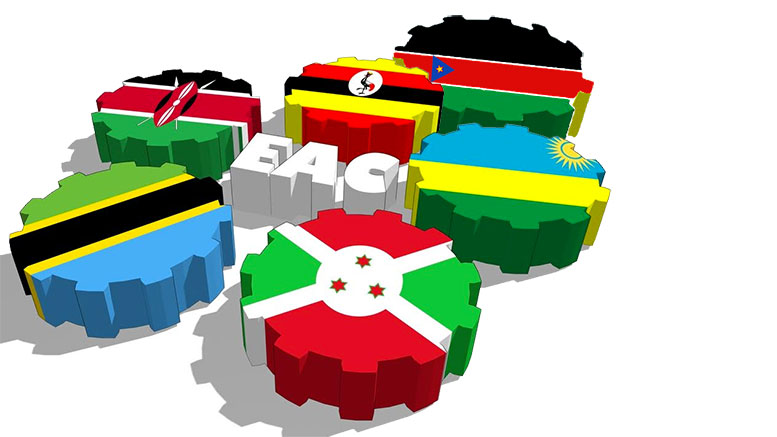
The EAC, comprising eight member states—Kenya, Tanzania, Uganda, Rwanda, Burundi, the Democratic Republic of the Congo (DR Congo), South Sudan, and Somalia—represents a dynamic bloc with a combined population exceeding 300 million and vast potential for trade and integration. The IMF's World Economic Outlook data, released in its January 2026 update, paints a picture of steady regional advancement, with East Africa's overall GDP growth outlook strengthening to around 6.1% by 2026, up from 4.4% in 2024.
This growth is fueled by increased foreign direct investment, commodity exports, and efforts to enhance intra-regional trade under the African Continental Free Trade Area (AfCFTA).
Here is a breakdown of the projected nominal GDPs for EAC countries in 2026, based on IMF data:
Country Kenya-140.87
Tanzania-95.35
DR Congo-88.13
Uganda-72.46
Rwanda-15.47
Somalia-13.91
Burundi-9.21
South Sudan-6.03
These figures reflect nominal GDP in current U.S. dollars, highlighting disparities influenced by factors such as population size, resource endowments, and political stability.
Kenya's lead is attributed to its diversified economy, encompassing services, agriculture, manufacturing, and a burgeoning tech sector in Nairobi's Silicon Savannah. The country's GDP has expanded from approximately $115 billion in 2022 to the projected $140 billion in 2026, representing a roughly $25 billion increase over four years—a growth equivalent to the combined GDP of several smaller counties in the region.
Tanzania follows closely as the second-largest economy, with $95.35 billion, bolstered by mining, tourism, and port developments in Dar es Salaam. DR Congo, rich in minerals like cobalt and copper, is projected at $88.13 billion, though ongoing conflicts in the east hinder fuller potential. Uganda's $72.46 billion projection is driven by oil discoveries and agricultural exports, while Rwanda's efficient governance and focus on services contribute to its $15.47 billion estimate.
Smaller economies like Somalia ($13.91 billion) show resilience despite historical challenges, with growth potential in livestock, fisheries, and remittances. Burundi and South Sudan, at $9.21 billion and $6.03 billion respectively, face hurdles from political instability and reliance on aid, but both are poised for recovery through regional integration.
While these projections are optimistic, experts caution that actual outcomes depend on global commodity prices, climate impacts, and domestic policies. Kenya's growth rate is forecasted at 4.9% for 2026, slightly below the regional average, trailing faster-growing neighbors like Uganda and Rwanda.Public discourse on social media has highlighted mixed sentiments: some celebrate the expansion, while others question whether economic gains trickle down to citizens amid rising debt levels—Kenya's public debt stands at about 70% of GDP—and inequality.
As the EAC pushes for deeper economic union, including a common currency and customs union, these IMF figures serve as a benchmark for policymakers. Kenya's leadership role could drive collaborative initiatives, such as joint infrastructure projects, to elevate the entire region's prosperity in the years ahead.