
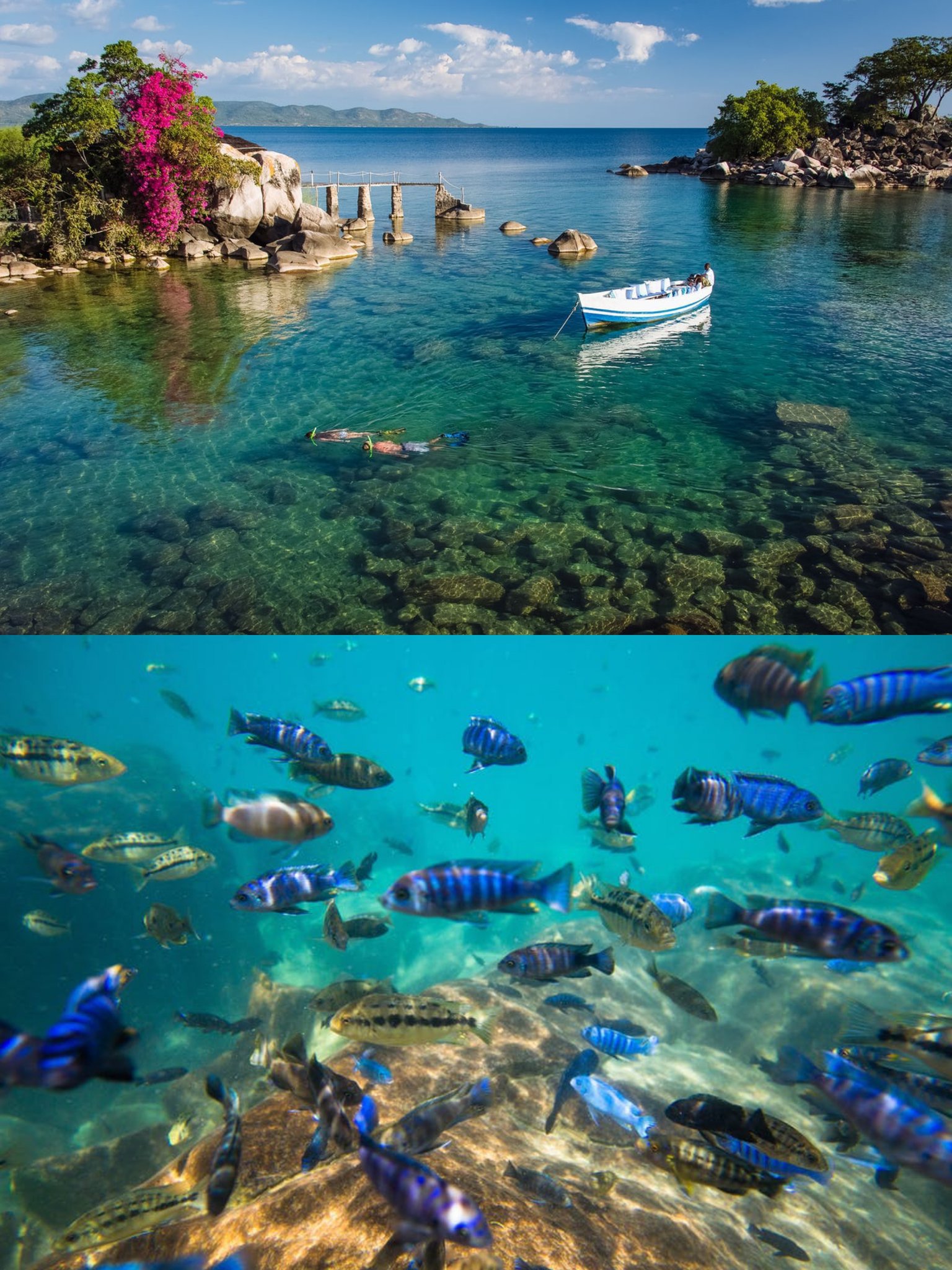
. It contains more fish species than any other lake on Earth, with estimates ranging from roughly 800 to over 1,000 species. The majority are endemic cichlids found nowhere else in the world.
This extraordinary biodiversity has earned the lake recognition from Guinness World Records as the lake with the most fish species and has made part of its southern shores a UNESCO World Heritage Site.
Lake Nyasa ranks as Africa’s third-largest lake by surface area, covering approximately 29,500–29,600 square kilometres. It is the continent’s second-deepest lake, plunging to a maximum depth of about 706 metres, and ranks among the world’s largest freshwater lakes by volume. Its long, narrow shape stretches more than 500 kilometres, creating a mosaic of habitats: rocky shores, sandy bottoms, open pelagic waters, and varying depths and temperatures.
The lake’s fish fauna is dominated by the family Cichlidae. Scientists estimate that 90–99% of its cichlid species are endemic. These fish represent one of the most striking examples of adaptive radiation—the rapid diversification of a single ancestral group into many forms that exploit different ecological niches—among vertebrates. Most of the cichlids appear to have evolved from a small number of ancestors that entered the lake within the last few million years. Several factors drove this explosion of diversity: varied habitats that allowed specialization (the colourful “mbuna” rock-dwellers are a well-known example); dramatic historical fluctuations in water levels, with sediment records spanning 1.3 million years showing that lake levels dropped by more than 200 metres roughly 24 times, repeatedly isolating populations and promoting speciation; and sexual selection and behavioural isolation that reinforced differences between groups.
The result is a living laboratory of evolution, often compared to Darwin’s finches in the Galápagos Islands. Popular accounts sometimes note that the lake harbours a substantial share—around 15% in some estimates—of the world’s known freshwater fish species, though precise global figures depend on ongoing taxonomic work. Many species remain undescribed.
Beyond its scientific value, Lake Nyasa is vital to the people who live around it. Fisheries support tens of thousands of fishers and, through the broader value chain, the livelihoods of more than 1.6 million people. In Malawi, the lake has historically provided a major portion of dietary animal protein. Colourful mbuna cichlids also fuel an international aquarium trade. The lake’s clear waters and surrounding landscapes attract tourists, while its role as a flyway for migratory birds adds further ecological significance.
Like other African Great Lakes, Lake Nyasa faces growing threats: overfishing (including destructive gear), pollution from agriculture and urban areas, habitat degradation, climate change, and invasive species such as Nile tilapia. Some commercially important native species have declined, and certain endemic forms have collapsed in parts of the lake.
Conservation efforts include protected areas such as Lake Malawi National Park, community-based fisheries management, monitoring programmes, and initiatives to promote sustainable practices. Continued research and international cooperation remain essential to safeguard this unique ecosystem.
Lake Nyasa stands as a powerful reminder of nature’s capacity for innovation. In one body of water, evolution has produced a diversity of fish unmatched anywhere else on the planet. Protecting it preserves not only a source of food and livelihood for millions but also an irreplaceable window into how life diversifies and adapts.The next time you see a brightly coloured African cichlid in an aquarium, it may well trace its ancestry to the clear, deep waters of Lake Nyasa—one of Earth’s greatest living treasures.