
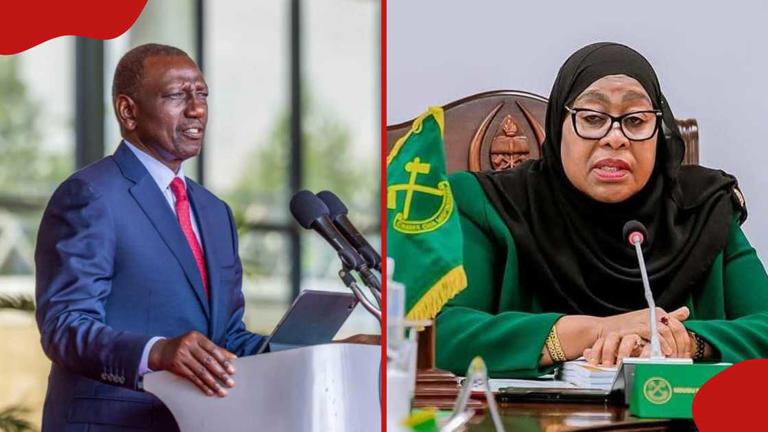
The response came quickly after the Kenyan President spoke during a church service on April 19, 2026, where he explained why fuel prices in Kenya remain high. President Ruto had noted that Kenya maintains around 20,000 kilometres of tarmacked roads, a figure he said exceeds the combined total of several neighbouring countries including Uganda, Rwanda, Burundi, South Sudan, and the Democratic Republic of Congo.
In his address, President Ruto argued that Kenya, as a middle-income country, carries a heavier burden in maintaining its extensive road network. He suggested that comparisons should be made with other middle-income nations rather than with least-developed countries in the region. The remarks were intended to justify the cost of fuel in relation to the expenses of building and repairing roads across Kenya.
On April 21, 2026, Tanzania’s Minister for Works, Abdallah Ulega, dismissed the claims as misleading and inaccurate. He stated that Tanzania alone has about 16,000 kilometres of tarmacked roads in both urban and rural areas. When combined with the networks of other East African countries, the total exceeds 22,000 kilometres, according to the minister. He also emphasised that Tanzania is a lower-middle-income country, just like Kenya, and that the two nations are the main peers in that category within East Africa.
The exchange has sparked discussions about infrastructure development and economic standings among East African neighbours. While President Ruto highlighted Kenya’s achievements in road construction, the Tanzanian side defended its own progress and rejected any suggestion of being left behind. Such public differences between friendly nations are not uncommon when leaders discuss development matters, but they often draw attention to the need for accurate data and continued regional cooperation. Many observers hope the conversation will encourage both countries to focus on improving transport links that benefit citizens across borders rather than engaging in comparisons.