
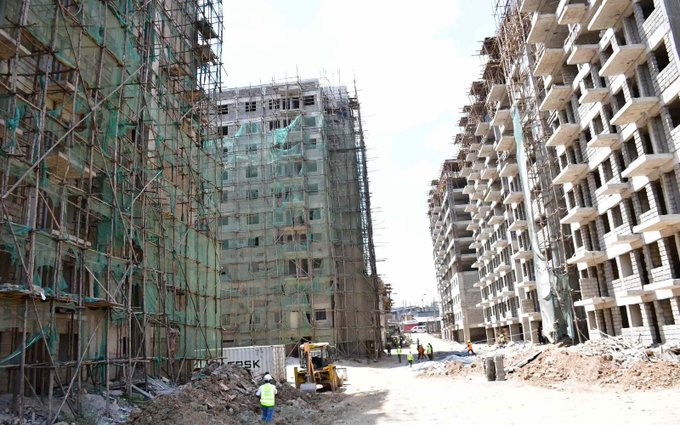
More than 170 projects under President William Ruto’s Affordable Housing Programme have stalled as the initiative faces a significant financing gap of Sh118.3 billion in the current financial year, according to a new report from the Parliamentary Budget Office.The State Department for Housing and Urban Development requires Sh228.3 billion to keep ongoing work on track in the 2026/27 budget, but lawmakers approved only Sh110 billion. Officials warn that the shortfall risks further delays, higher costs from contractor penalties, and rising material prices caused by prolonged construction timelines.
Across the programme, 1,186 projects valued at roughly Sh1.8 trillion are under way. Of these, 1,010 remain active while 176 have already stopped. The stalled projects break down as follows: 16 under the core affordable housing category, 22 under social housing and slum upgrading, 91 institutional and student housing schemes, and 47 social and physical infrastructure works.A stalled project is defined as one that has shown no progress for more than 12 months, typically due to funding shortages, contractor issues, or administrative delays.Financial progress remains limited.
By the end of June 2026, only Sh198 billion had been spent on development against a total project cost of about Sh1.758 trillion — roughly 11 percent overall. Breakdown by portfolio shows affordable housing at 14 percent completion on funding, social housing and slum upgrading at 18 percent, institutional and student housing at just 3 percent, and infrastructure at 31 percent.
The programme is primarily funded through the National Housing Development Fund, which draws most of its money from the Affordable Housing Levy. Collections so far total Sh205.7 billion, with annual figures rising from Sh53.4 billion in 2023/24 to Sh79.1 billion in 2025/26.The Parliamentary Budget Office is urging a shift in approach for the new financial year. Instead of launching additional projects, the government should focus on completing those already under way. Priority should go to schemes that are near completion, have strong infrastructure readiness, and offer clear social or economic returns. Funds from the Housing Levy should be ring-fenced for projects under active contracts that are approaching practical completion, helping convert public spending into finished, saleable homes more quickly.