
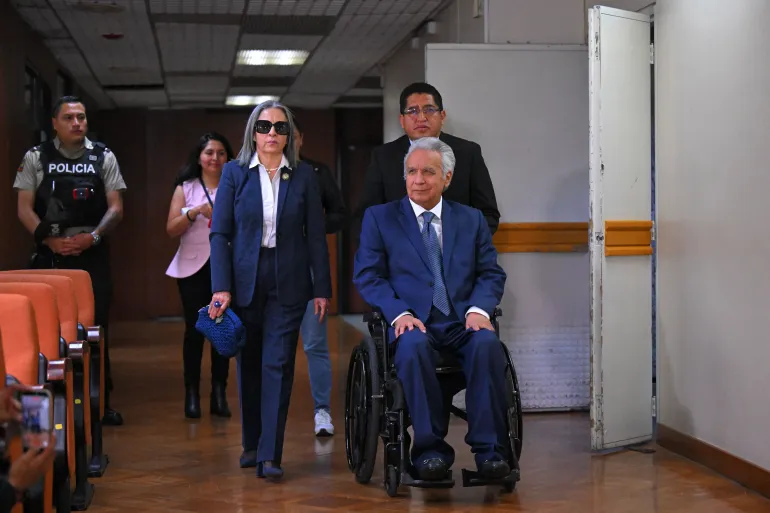
The ruling, announced by the public prosecutor’s office on Friday, centres on the Coca Codo Sinclair plant, a massive facility that began operations in 2016 yet has been plagued by technical failures ever since. Investigators traced an alleged corruption network involving Moreno, members of his family, and both local and Chinese business partners, claiming that Chinese state-owned contractor Sinohydro funnelled roughly 76.1 million dollars in bribes between 2009 and 2018 through a web of fraudulent consulting contracts.
Judge Manuel Cabrera, heading the tribunal, declared that Moreno’s actions aligned squarely with the charges of bribery by a public official. Prosecutors detailed how the illicit funds travelled through overseas accounts and shell companies registered in tax havens before reaching the former leader’s circle. While Moreno served as vice president from 2007 to 2013, he and close relatives allegedly received more than one million dollars from the scheme. His wife, daughter, two brothers and their wives each received sentences of two and a half years, while China’s former ambassador to Quito, Cai Runguo, was handed the same five-year term as Moreno himself.
The former president has steadfastly rejected every accusation, maintaining he played no part in negotiating or supervising the contracts. During the hearing he told the court, “You’re looking in the wrong place. Look at those who signed the contracts, at those who had the habit of demanding kickbacks.” Moreno, who led the country from 2017 to 2021, had been living in Paraguay before returning voluntarily to confront the charges. The investigation itself was opened in March 2023, reflecting years of mounting scrutiny over the troubled hydroelectric venture and the broader questions it raises about foreign-backed infrastructure deals across Latin America.
Beyond the courtroom, the verdict carries weight for a nation still grappling with the long-term consequences of the plant’s underperformance and the public distrust that corruption scandals inevitably deepen. Families of those affected by the project’s shortcomings, as well as citizens who once placed their faith in Moreno’s leadership, now confront the reality of a high-profile conviction that reaches into both political and diplomatic spheres. The inclusion of a former foreign ambassador among the convicted underscores how deeply international partnerships can become entangled in domestic accountability processes.
As Moreno prepares to begin his sentence and the remaining defendants face their own terms, the case stands as a rare instance of a former head of state being held to account for alleged graft tied to a flagship national project. The outcome may yet influence how future administrations approach large-scale infrastructure agreements and the transparency mechanisms that surround them, leaving the country to weigh the costs of past decisions against the possibility of stronger institutional safeguards ahead.