
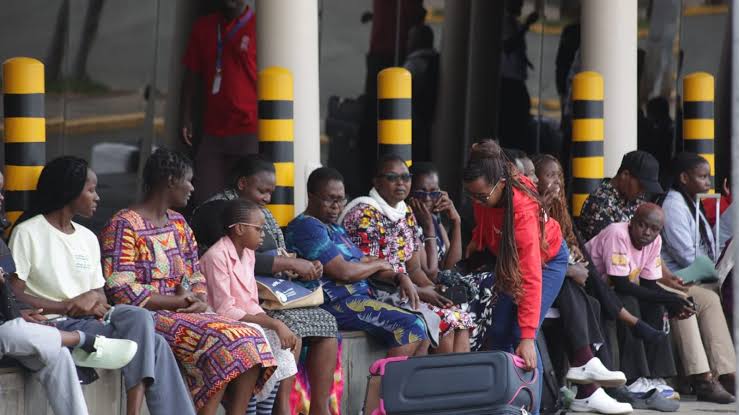
What began as a planned departure for many turned into an unexpected vigil on the hard seats and tiled floors of the country’s busiest aviation hub. Families with young children, business travellers clutching laptops, and tourists clutching boarding passes that suddenly meant nothing all shared the same uncertain hours. By Monday morning, the scene had shifted only slightly as several carriers began organising hotel transfers, offering temporary relief but no clear timetable for when flights might resume. The disruption rippled outward from the capital, leaving passengers elsewhere equally adrift and underscoring how quickly a labour dispute can freeze the movement of people and goods across the nation’s skies.
The industrial action, organised by the Aviation Workers Union, took the form of coordinated go-slows and full work stoppages that began on Sunday. Union members at the Civil Aviation Authority, the Airports Authority and the local carrier Jambojet laid down their tools, insisting they would not return until long-standing concerns over pay, working conditions and previously negotiated benefits were addressed. The effect was immediate and widespread. Operations slowed to a crawl not only at the main international gateway but also at the coastal facility in Mombasa, stranding travellers who had expected to connect or depart on schedule. What had been routine check-ins and departures dissolved into long queues, cancelled flights and a growing sense of frustration among those who simply wanted to reach their destinations.
Union Secretary General Moss Ndiema made the position plain, stating that members had withdrawn their labour from the three institutions and would remain away until every outstanding grievance was resolved. The decision followed the breakdown of a framework agreement reached in late July, when the Cabinet Secretary for Roads and Transport had brought the union and the employers to the table and set a timetable for direct talks. That process collapsed, leaving the workers convinced that only sustained pressure would force meaningful progress. For passengers, the institutional deadlock translated into personal inconvenience measured in missed meetings, delayed reunions and the simple exhaustion of spending a night under fluorescent lights with little information.
Beyond the immediate chaos, the episode revealed deeper tensions that have simmered within the aviation sector for months. Staff argue that improved welfare and the honouring of earlier commitments are essential to maintaining safe and efficient operations. Employers and government intermediaries, for their part, face the challenge of balancing those demands against operational costs and service continuity. In the meantime, ordinary travellers absorb the cost in lost time and mounting anxiety. Hotel transfers offered a partial solution for some, yet many still waited for clearer guidance, their journeys suspended while the dispute continued to play out behind closed doors.
As the second day of disruption unfolded, the human dimension remained the most visible. Parents soothed restless children on terminal benches, elderly passengers sat quietly with their luggage, and airline staff moved among the crowds offering what reassurances they could. The episode serves as a reminder of how tightly the country’s air travel network is woven into daily life and economic activity. While negotiations may eventually restore normal service, the memory of a night spent in the airport will linger for those who lived through it, a quiet illustration of the real-world consequences when labour relations reach an impasse and ordinary people find themselves caught in the middle.